 Skip-the-line available
 What to See at Rynek Underground
The medieval excavations, holograms and artefacts that make up Kraków's underground museum — what's actually down there, and what to look for.
Rynek Underground isn't a conventional collection of objects in cases — it's a walk through the real excavated remains of medieval Kraków's marketplace, four metres beneath the modern square, brought to life with projections and multimedia. Here's what's actually down there, drawn from the museum's own "In the Footsteps of Kraków's European Identity" exhibition, so you know what to look for.
The excavations beneath the glass
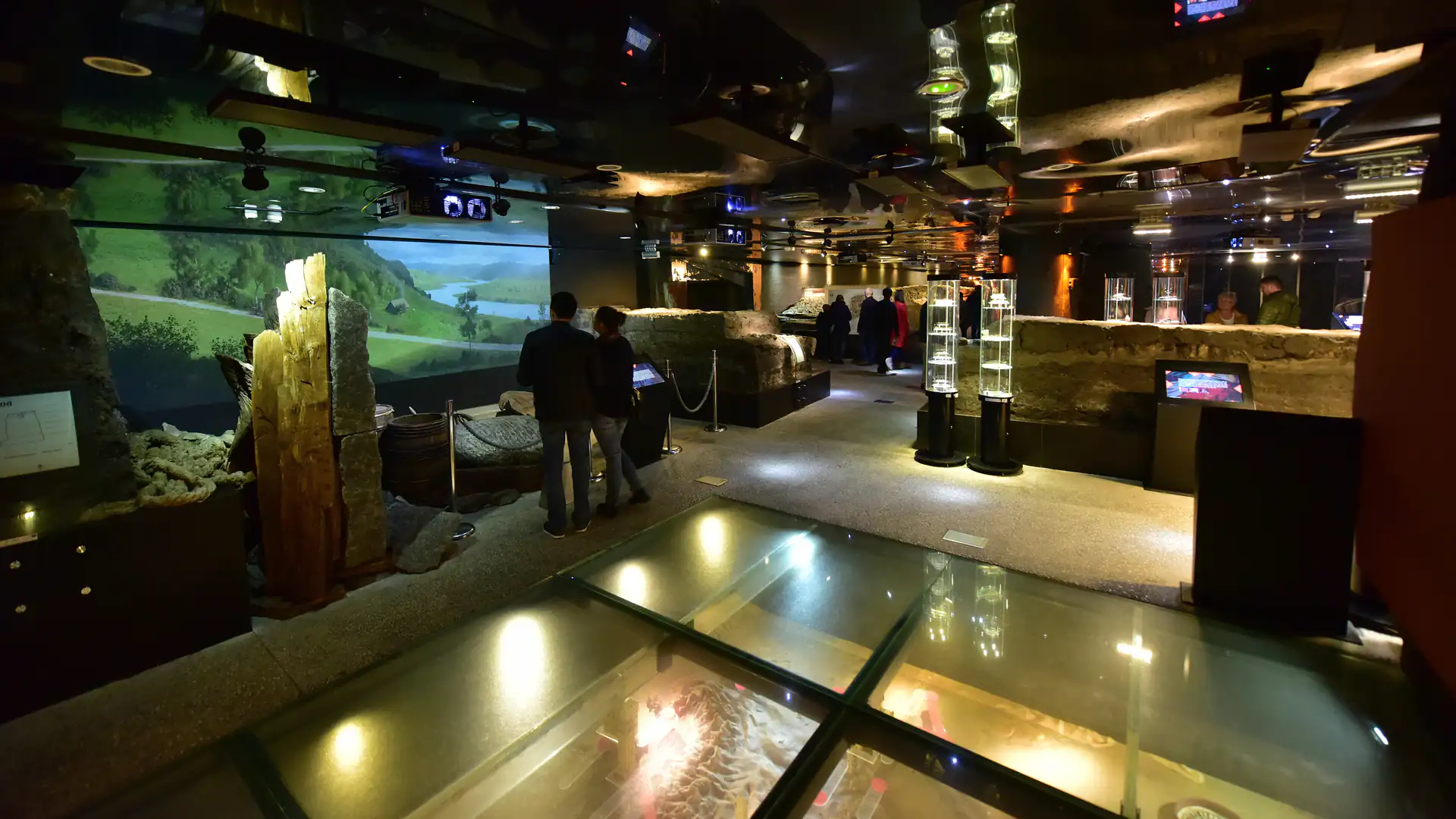
The core of the museum is the archaeology itself: glass walkways suspended over the genuine excavated remains of the medieval market — building foundations, the layout of old streets, and the remnants of an eleventh-century settlement that burned down and was later built over. You're walking above real ground, not a reconstruction.
Among the excavated structures is a reconstructed 12th-century workshop and the remains of the city's early waterworks — engineering details that show Kraków was a functioning, organised trading town centuries before the Cloth Hall above it existed.
Trade-route artefacts and the market economy
Kraków sat on major trade routes between eastern and western Europe, and the exhibition's artefacts trace that commerce directly: medieval coins and currency, merchants' weights, tools, and a reconstructed merchant's stall showing how goods were laid out and sold on the market square.
One of the most talked-about single objects is a large medieval lead ingot — reportedly around 693 kg — a striking, physical sense of the scale of goods moving through the market in the Middle Ages. Maps and displays trace the trade routes that brought goods, and wealth, into the city.
Holograms, fog and multimedia
What sets Rynek Underground apart from a standard archaeological museum is its use of holograms, projectors and fog effects to recreate scenes of the market as it stood roughly seven hundred years ago — merchants, buyers and the working life of the square projected onto and around the real excavated space.
Interactive touchscreens let you explore 3D models of how the market and its buildings evolved over the centuries, which is particularly useful for visitors trying to picture how the streets above connect to what you're seeing below.
How the story is told, room by room
The exhibition is arranged as a route rather than a single hall, moving chronologically and thematically through the market's history — early settlement, the rise of organised trade, the medieval market's daily life, and the transformations that shaped the city into what stands above today.
It rewards unhurried pacing: at roughly 75 minutes for a typical visit, there's enough here to read the display panels, watch the projected scenes play through, and take in the excavations properly rather than rushing the route.
Frequently asked
Is Rynek Underground mostly artefacts or mostly multimedia?
Both — genuine excavated remains and medieval artefacts form the core, brought to life with holograms, projections, fog effects and interactive touchscreen models rather than static text panels alone.
What's the single most memorable exhibit?
Opinions vary, but the glass floors over the real excavated medieval streets, and the large medieval lead ingot (around 693 kg), are two of the most talked-about elements.
Is it a lot of walking?
It's a self-paced walking route through the underground space, with glass walkways and some uneven surfaces over the excavations — comfortable footwear is worth it.
Are display panels in English?
The exhibition is designed for international visitors with English-language information alongside Polish; we'll flag anything unusual for your visit.
How long should I allow to see everything?
About 75 minutes is typical for an unhurried visit through the full route.